
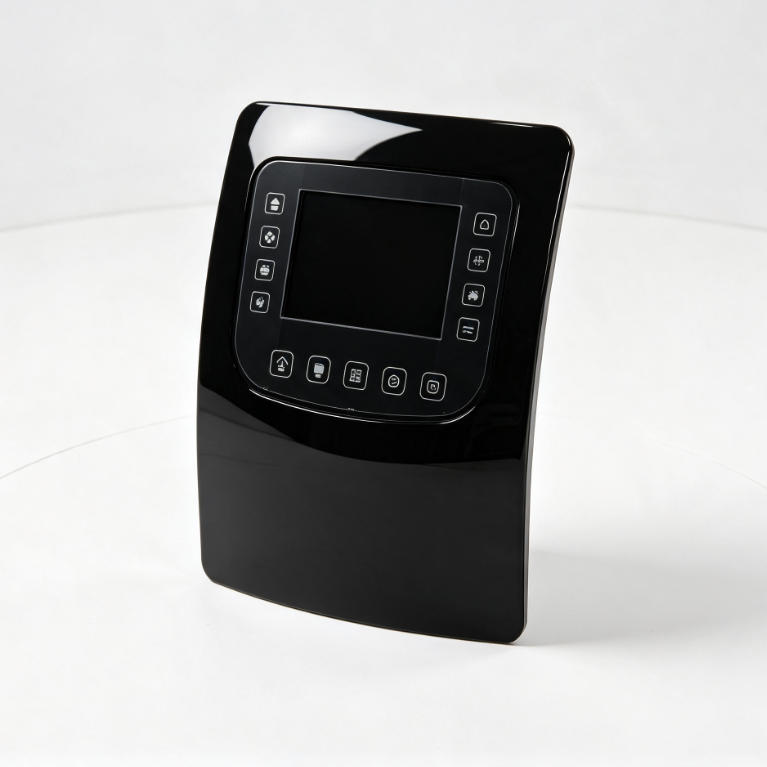
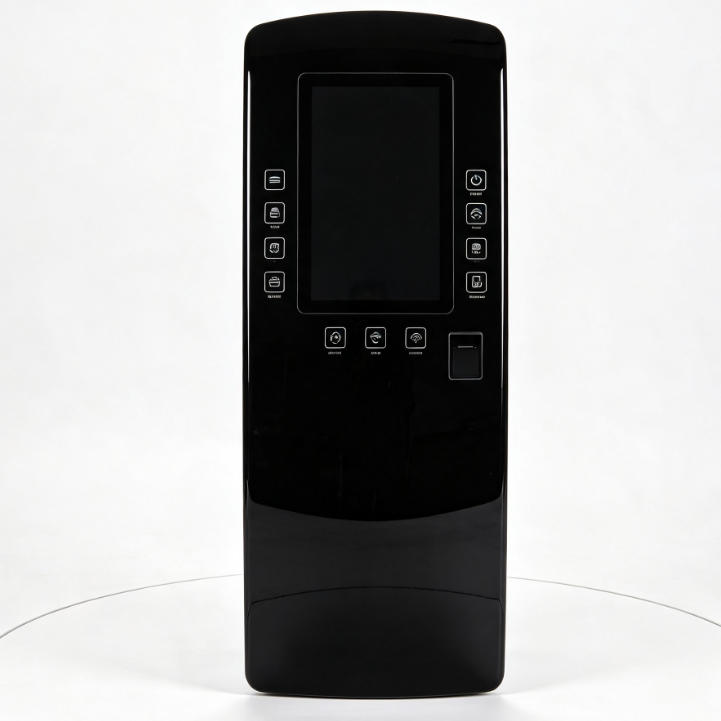
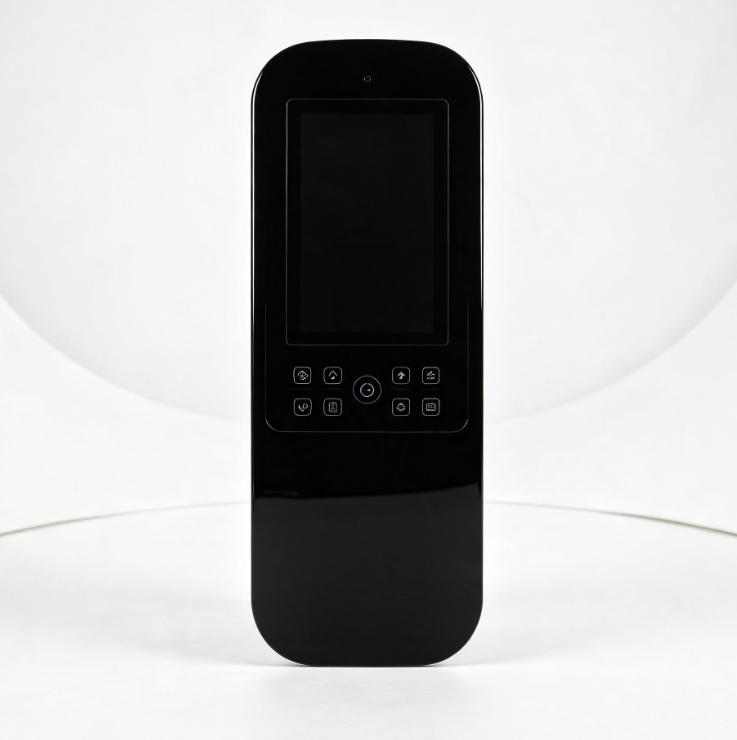
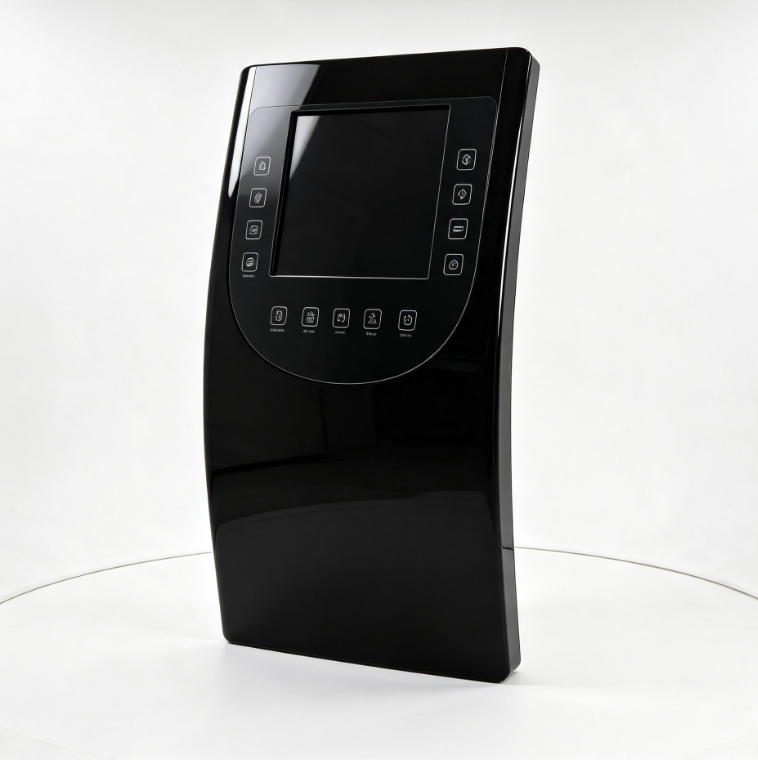
Custom IMD panels: the graphic is in the part, not on it
This line is in-mold decorated injection components, not a sticker on a painted bezel and not a loose printed film. A formed, printed film is placed in the cavity; resin fills behind it so the artwork, dead-front icons, and texture become the A-surface. Fingers, cleaners, and coin-slot traffic wear the film from the inside out, not off the face. You send a 3D model, a stack-up, and vector art. We run a first-article shot, then lock the tool for the production lot.
OEM buyers searching for custom IMD bezels, in-mold decorated control panels, or IML appliance faces use this category when the cabinet already has a glass door and still needs a durable branded front. It is not glass silk-screen and not a profile extrusion. Those are other processes. IMD is for three-dimensional covers, payment columns, handle caps, and display windows that must look like one piece. We can ship the part alone or assemble it to a smart vending door or cooler leaf on the same PO.
IMD, IML, IMR — what we actually run
IMD / IML (in-mold labeling / decoration). A printed polycarbonate or similar film is thermoformed, trimmed, and insert-molded. The ink sits behind a wear layer. Backlighting and dead-front (icons invisible until the LED is on) are normal requests on vendor and appliance panels. See in-mould decoration.
IMR (in-mold roller). A carrier foil transfers the decoration in the tool and then peels away. Good for high-volume, flatter cosmetics. Deep 3D and heavy wear faces usually stay on formed-film IMD.
Resin is typically ABS, PC, PC/ABS, or PMMA, matched to the film so the melt does not wash the ink. That pairing is a process window, not a catalog checkbox. We will not drop a cheap PP behind a high-gloss piano film and call it a lounge bezel. Injection moulding still owns warp, gate blush, and knit lines; the film does not hide a bad tool.
Custom production — what we freeze on the PO
3D and stack. STEP/IGES of the part, wall thickness, gate side, display and sensor cutouts, snap fits, and the film-to-resin stack (wear layer, print layers, bonding layer). Artwork in vector with Pantone / RAL and a dead-front map.
Function. Gloss or matte; soft-touch; metallic or wood look; capacitive-key print; IR/camera windows; light-pipe or smoked lens areas. If the panel sits on a refrigerated door, say so — film and resin must take the dew and the cleaner list.
Tool. New family tool or an insert in an existing frame. Side actions for snaps and windows are called out before steel. Cosmetic faces get the steel polish the film needs, not a generic SPI guess.
Process. DFM → film print and form trial → T0/T1 shots → first-article dimensional + visual (AQL on print register) → your hang test on the cabinet → production. MOQ follows cavity count and film print. Art changes after film cylinders or screens are made are a new film lot, not a free reprint.
Where the parts go
Smart-vending payment columns and selector plates, cooler and wine-cabinet brand bezels, appliance control panels, handle inserts, locker-door cosmetics, and interior covers that must stay graphic after years of wipe-down. Indoor commercial is default. Outdoor or UV-facing parts need the film UV package named on the RFQ.
Typical specifications (custom; confirm on the tool kickoff)
| Item | Specification |
|---|---|
| Product | Custom in-mold decorated (IMD / IML / IMR) components |
| Process | Printed film insert-molded or in-mold roller transfer |
| Typical resins | ABS, PC, PC/ABS, PMMA |
| Film | PC or specified decorative / dead-front film |
| Finish | Gloss, matte, soft-touch, piano, metallic, woodgrain |
| Features | Display windows, IR/camera holes, capacitive icons, snaps |
| Secondaries | CNC, laser, EMI ink, assembly to glass or extrusion |
| Tooling | New mold or insert from 3D + 2D |
| Production | OEM / ODM; first-article part then batch |
Send the 3D, artwork, annual quantity, resin preference, and whether the part sees cold or UV to the IMD desk. We will reply with a DFM note, a film stack, and a first-article date.
How to write the custom PO
State: custom IMD component; resin; film type; part number / 3D file; finish; quantity; any backlight or capacitive function. Attach STEP and vector art. Do not write only the category name. Do not specify “pad print on ABS” when you need in-mold film.
Questions OEM buyers ask
IMD or just silk-screen the plastic?
Silk-screen or paint is cheaper on flat, low-wear parts. IMD when the face is 3D, high-wear, or must stay glossy with dead-front icons. We will say if print-on-resin is enough.
Can you match our existing bezel?
Yes, from a sample part plus artwork. Deep texture and metallic flop need a signed visual standard under agreed lighting, not only a hex code.
Will the film peel at the gate?
That is a gate, melt-temp, and film-bond issue. It is solved in T1, not with glue after molding. First-article includes a cross-section at the gate if you ask.
One tool for left and right / colorways?
Often one tool and several films. Mechanical changes need steel. Colorways are a film change if the geometry stays.
Sample path?
Film trial → T0/T1 → first-article pack (dims, print register, adhesion) → your cabinet fit → production. New tools always go through that path.